2025.10.03
Changing vibrations to power! CTI Engineering successfully conducts a demonstration experiment related to energy harvesting technology that will pave the way to the future of bridge inspections: solutions for supplying power, which has been the bottleneck
Technology & Research
Our company collaborates with JVCKENWOOD Public & Industrial Systems Corporation and a research group led by Program-Specific Researcher Tomoki Nishino and Professor Tomomi Yagi of Kyoto University to promote the development of energy harvesting* technology that applies speaker principles to convert vibrations to electrical energy. In February 2025, we conducted an actual demonstration experiment at a bridge and successfully generated power.
* Energy harvesting: the collection of small amounts of energy, including vibrations, heat, and light, from the nearby environment to convert and use it as electricity
1. Development background and objectives
A great deal of Japan's social infrastructure was developed during the country's high-growth period (in the 1960s and 1970s), and, as this infrastructure ages, safety and operational issues are becoming apparent. The introduction of monitoring technology that utilizes sensors has been promoted as a way to manage such issues, but supplying enough power to integrated systems that handle the recording and sending of acquired data is an issue.
Our company is aiming to develop a bridge monitoring system that utilizes power generation technology based on the use of bridge vibrations to achieve independent electromagnetic sensors with vibration-energy harvesting functions that enable inspection and monitoring in the long term. More specifically, we will apply dynamic speaker principles to generate power from low-frequency vibrations and operate this system (Fig. 1). This will enable us to secure a power supply and reduce both the wiring and associated maintenance costs.
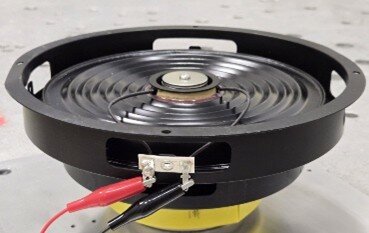
Fig. 1 An energy harvester prototype
2. Demonstration experiment overview and results
During this demonstration experiment, we verified that it is possible to use the vibrations that occur when automobiles pass over a bridge to generate power by using energy harvesting technology. As a result, we harvested dozens of volts of energy, and we demonstrated that it is possible to generate power from vibrations even in the lower-frequency range, which was difficult to achieve when using past technology.
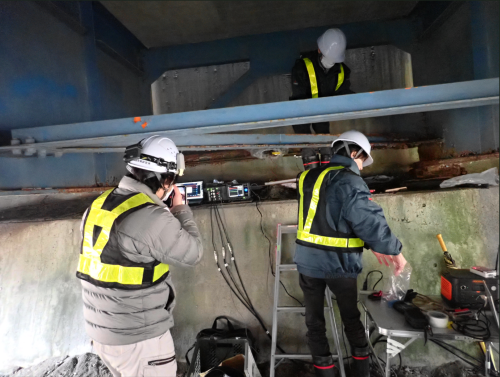
Fig. 2 Our demonstration experiment
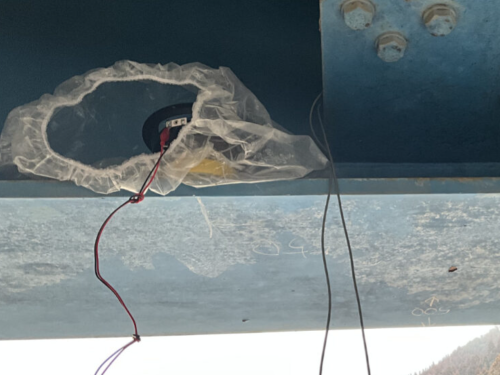
Fig. 3 An installed energy harvester prototype
3. Future initiatives
This technology will enable us to more easily achieve the remote monitoring of bridges and other aging structures, thereby gaining an understanding of signs of possible disasters as well as damage.
Going forward, we will promote the implementation of this technology as we aim to contribute to reducing the necessary labor and costs of infrastructure maintenance management.